


Mental Stimulation Toys for Dogs: Which Types Help Most With Boredom?
Dogs do not get bored simply because they have extra energy. They get bored when their brains have nothing meaningful to do. The best mental stimulation toys for dogs are the ones that make a dog solve a problem, search with purpose, or work through a sequence of actions instead of mindlessly chewing for five minutes.
If your dog paces, stares at you all afternoon, steals socks, barks at hallway sounds, or seems unable to settle indoors, enrichment toys can help by giving that mental energy a job. The trick is choosing the right type of challenge for your dog’s motivation, play style, and frustration level.
Quick Answer: Which Toy Types Help Most With Boredom?
The most effective interactive dog toys for mental stimulation usually fall into four categories: treat-dispensing toys, puzzle toys, sniff-and-search enrichment toys, and problem-solving chew or manipulation toys. Food-motivated dogs usually engage longest with toys that reward effort with treats, while non-food-motivated dogs often do better with toys that trigger chasing, disassembly, scenting, or tactile exploration.
A good boredom toy should do at least one of these things:
- make your dog think before getting a reward
- slow down access to food or treats
- encourage sniffing, pawing, nudging, rolling, or lifting
- hold attention for longer than a simple fetch throw
- end with your dog feeling satisfied rather than overstimulated
Why Mental Stimulation Matters for Dogs
Mental enrichment is not just a nice extra for “smart” breeds. It matters for almost every dog, especially dogs that spend long hours indoors, live in apartments, recover from injury, or cannot get unlimited physical exercise.
When dogs have no outlet for curiosity and problem-solving, boredom often shows up as:
- chewing furniture or household items
- demand barking
- restless pacing
- jumping on people
- scavenging and counter surfing
- obsessive toy destruction with no real engagement
Mentally stimulating dog toys help because they mimic parts of natural canine behavior. Snuffle mats encourage foraging. Puzzle feeders reward persistence. Treat balls make a dog experiment with movement and timing. Tug-based problem toys can satisfy grip and possession instincts. These are all forms of “work,” and dogs usually relax better after meaningful work than after random excitement.
For apartment dogs, this matters even more. A short enrichment session in the living room can tire a dog more effectively than aimless indoor play because the brain is doing the heavy lifting.
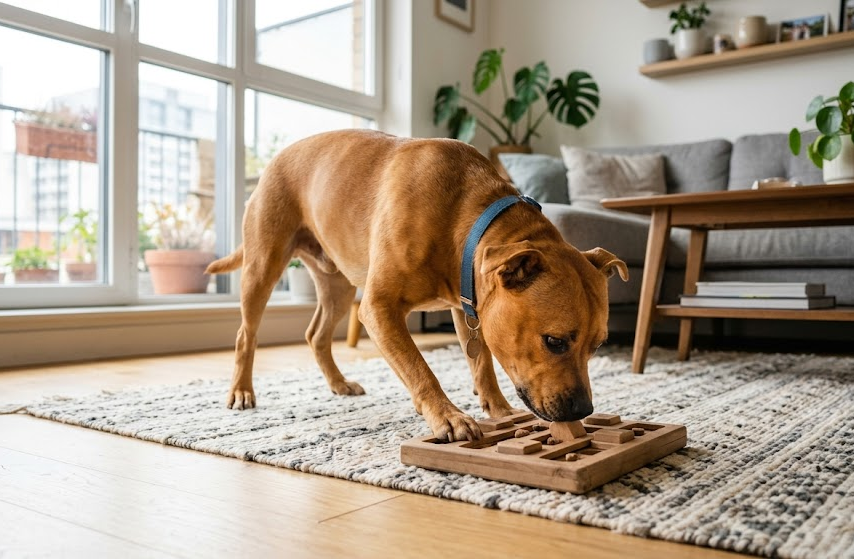
Toy Categories That Challenge the Brain Differently
Not all dog enrichment toys work in the same way. Some create a food puzzle, some trigger scent work, and some ask the dog to manipulate objects with the nose or paws. Matching the toy type to the boredom pattern matters more than buying the most expensive option.
1. Treat-Dispensing Toys: Best for sustained solo focus
Treat-dispensing toys are often the easiest place to start because the reward loop is obvious. The dog nudges, rolls, paws, or mouths the toy, and food appears. That cause-and-effect pattern can keep many dogs engaged much longer than a plush toy or plain rubber chew.
These toys help most when your dog:
- loves kibble or treats
- eats too fast from a bowl
- needs a calmer indoor activity
- is new to enrichment and gets frustrated easily
For example, a simple treat-dispensing tumbler ball can work well for beginners because the challenge is active but not too hard. A product like this treat-dispensing dog food ball makes sense for dogs that enjoy batting, nosing, and chasing food rewards around the floor. It is not the most advanced puzzle on the market, but it matches the real reason many owners search for boredom toys for dogs: they want something easy to introduce and likely to hold attention right away.
Best use case: dogs that get antsy before meals, dogs left alone for short periods, and high-energy dogs that need a structured activity indoors.
2. Puzzle Toys: Best for smart dogs that need a harder challenge
Puzzle toys usually ask a dog to flip lids, slide panels, lift covers, or move pieces in the right order. These are strong choices for interactive toys for smart dogs because they slow the dog down and reward patience, memory, and experimentation.
They help most when your dog:
- solves easy toys very quickly
- gets bored after basic treat balls
- enjoys using paws as well as the nose
- stays engaged without becoming frantic
The catch is that advanced puzzle toys can become ineffective if they are too hard. When the challenge is beyond the dog’s current skill level, the toy stops being mentally stimulating and starts becoming frustrating. The best approach is to begin with one-step puzzles and build upward.
3. Snuffle Mats and Nose Work Toys: Best for anxious or overaroused dogs
Scent-based enrichment is underrated. Snuffle mats, treat scatter mats, and hide-and-seek plush toys tap into a dog’s natural foraging instincts. For many dogs, especially nervous dogs or dogs that become overexcited easily, sniffing provides a calmer kind of mental work than high-arousal chasing games.
These toys help most when your dog:
- inhales food too quickly
- seems anxious indoors
- needs a low-impact activity
- gets overwhelmed by more intense puzzle tasks
Best use case: rainy days, apartment living, crate rest, senior dogs, and puppies learning to settle.
4. Destruction-Appropriate Toys: Best for dogs that need to dissect and work
Some dogs are not bored because they need a puzzle board. They are bored because they need to bite, tear, peel, and dissect something safely. For those dogs, layered enrichment toys, tough chew toys with hidden rewards, or supervised “legal destruction” activities can work better than delicate puzzle games.
These help most when your dog:
- destroys plush toys quickly
- wants to pull things apart
- loses interest in stationary puzzles
- needs a satisfying outlet for chewing and gripping
This is especially relevant for high-energy breeds and adolescent dogs. A dog that likes to work with the mouth often needs mentally stimulating dog toys that include resistance, texture, or a hidden payoff.
5. Motion and Chase-Response Toys: Best for dogs that need engagement before thinking
Some dogs need movement first and problem-solving second. Toys that wobble, bounce unpredictably, or release food while rolling can hold attention because they trigger prey-like interest before shifting into a thinking task.
These can be useful for:
- puppies with short attention spans
- dogs that ignore static enrichment toys
- playful dogs that love chasing but need a calmer follow-through
The most effective versions combine movement with an actual challenge. Random motion alone is fun, but it does not always create lasting enrichment.
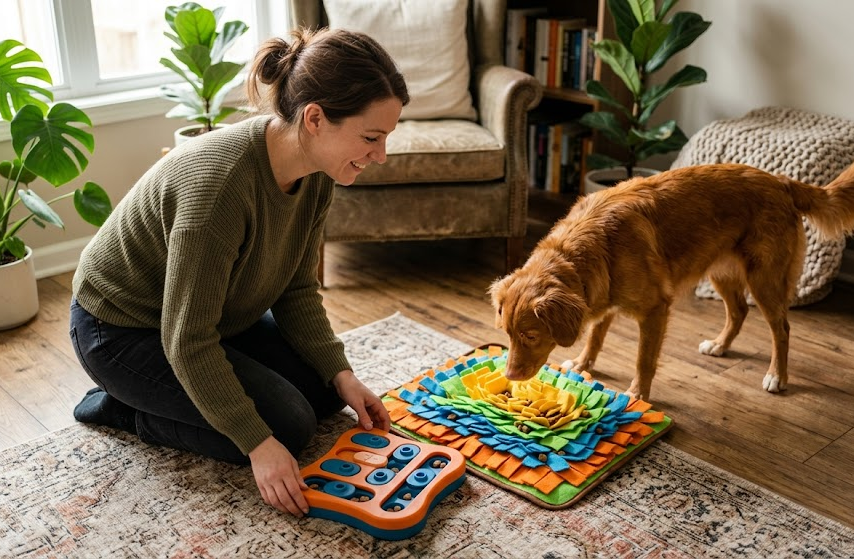
Best Options for Food-Motivated Dogs vs Non-Food-Motivated Dogs
One reason dog toys mental stimulation searches lead to disappointing purchases is that owners choose the toy they like, not the toy their dog is actually motivated to use.
For food-motivated dogs
Start with:
- treat-dispensing balls
- puzzle feeders
- wobble toys
- frozen fillable toys
- snuffle mats with part of the daily meal
These dogs tend to persist because the reward is clear. If boredom shows up around mealtime, replacing one bowl feeding with an enrichment toy session is often the fastest win.
For non-food-motivated dogs
Try:
- scent trails with favorite toys
- hide-and-seek plush toys
- tug-based problem toys
- supervised shred boxes with safe fillers
- toys that squeak, bounce, or move unpredictably
These dogs may care more about novelty, possession, movement, or scent than treats. They still need enrichment, but the reward system has to match what they value.
For puppies
Keep difficulty low and sessions short. Puppies often need variety more than complexity. Soft beginner puzzles, snuffle work, and simple treat balls usually outperform advanced multi-step toys.
For apartment dogs
Choose quieter enrichment tools that create focus without chaos. Snuffle mats, puzzle boards, lick-style calming enrichment, and food-dispensing toys are often better than toys that encourage constant crashing into furniture.
For high-energy dogs
Use layered enrichment. A brisk walk alone may not solve indoor restlessness. Pair movement with mental work by doing a short walk, then a food puzzle, then a chew-down period. That sequence often produces calmer behavior than exercise alone.
How Long Enrichment Sessions Should Last
Longer is not always better. A productive enrichment session is one that keeps your dog engaged without tipping into frustration or frantic behavior.
A practical guideline:
- beginners: 5 to 10 minutes
- moderately experienced dogs: 10 to 20 minutes
- advanced puzzle users: up to 20 to 30 minutes, depending on the toy and the dog’s temperament
Watch your dog, not the clock. A session should usually end when your dog looks satisfied, slows down naturally, or chooses to disengage. If your dog starts barking at the toy, biting it wildly, or giving up almost immediately, the challenge may be wrong.
For many dogs, one or two short enrichment sessions per day can noticeably reduce boredom-related behavior.
Mistakes That Make Enrichment Toys Ineffective
Even the best dog enrichment toys fail when the setup is wrong. These are the most common mistakes:
Making the toy too difficult too fast
If the dog cannot figure out the first step, the toy becomes stressful instead of rewarding.
Using the same toy in the same way every day
Novelty matters. Rotate toys and vary the reward pattern to keep interest high.
Choosing toys that do not match the dog’s motivation
A scent-driven dog may ignore a puzzle board. A food-driven dog may lose interest in a plush hide toy. Motivation fit matters more than trendiness.
Expecting enrichment to replace all exercise
Mental stimulation helps a lot, but most dogs still need physical movement, decompression walks, and social interaction.
Leaving difficult toys unsupervised too early
Supervision helps you see whether the toy is working, whether your dog is frustrated, and whether the material is safe for your dog’s chew style.
How to Choose the Right Toy Type for Your Dog
If your dog is bored, the best first step is not buying five random toys. It is identifying how your dog likes to work.
Use this quick selection guide:
- choose treat-dispensing toys for food-driven dogs that need easy, repeatable indoor engagement
- choose puzzle toys for experienced problem-solvers that enjoy multi-step tasks
- choose snuffle and scent toys for anxious, reactive, senior, or apartment dogs that benefit from calmer focus
- choose destruction-appropriate enrichment for dogs that need to tear, chew, and dissect safely
- choose motion-based interactive toys for dogs that need movement to become interested
Summary Takeaway
The mental stimulation toys for dogs that help most with boredom are the ones that match the dog’s natural motivation. For many dogs, food-dispensing toys and beginner puzzles provide the best starting point. For anxious dogs, scent-based enrichment may work better. For high-drive chewers, a tougher problem-solving toy or safe destruction outlet can be more satisfying than a standard puzzle board.
The goal is not to keep your dog busy at all costs. The goal is to give your dog meaningful work that leads to calmer behavior, better focus, and a more satisfied brain.
FAQ
Are puzzle toys or treat balls better for bored dogs?
Treat balls are usually better for beginners because the reward pattern is easy to understand. Puzzle toys can be better for dogs that already know how to problem-solve and need a harder challenge.
Do mentally stimulating dog toys tire dogs out?
Yes, many dogs become calmer after short mental work sessions because problem-solving, sniffing, and foraging use energy differently from physical exercise.
What if my dog loses interest in enrichment toys quickly?
The toy may be too hard, too easy, or simply a poor match for your dog’s motivation. Try a different category rather than assuming your dog dislikes enrichment.
How many enrichment toys does a dog need?
Most dogs do better with a small rotation of two to five useful toys than a huge pile of toys that all work the same way.
Leave a Reply