


Airline-Approved Cat Carrier Checklist: What to Measure Before You Fly
Flying with a cat gets much easier when you measure first and pack second. Before you leave for the airport, check your carrier’s exterior dimensions against your airline’s under-seat limit, confirm the interior gives your cat enough room to stand, turn, and lie down, and verify that the full setup is secure, ventilated, and easy to carry.
Quick Answer: The Pre-Flight Cat Carrier Measurements That Matter Most
If you only have a few minutes, check these six things before your trip:
- Carrier exterior dimensions: length, width, and height, including wheels, feet, side bulges, and top handles if they add to the total profile
- Carrier interior space: enough usable room for your cat to stand up, turn around, and rest naturally
- Your cat’s body measurements: nose to base of tail, shoulder height, body width, and current weight
- Airline policy details: cabin pet size limits, carrier style rules, weight caps, and route restrictions
- Seat-fit practicality: whether the carrier can compress slightly if the airline allows soft-sided carriers under the seat
- Travel-readiness details: ventilation, zipper security, absorbent liner, ID label, and easy access for screening
That is the core airline approved cat carrier checklist: measure the carrier, measure the cat, and match both to the airline policy before departure day.
Summary Takeaway
The best airline-approved cat carrier is not just one that matches a published size chart. It is one that fits your airline’s rules and gives your cat enough real interior room to travel safely and calmly.
Pre-Flight Measurement Checklist
Use this before you book, before you buy a carrier, and again 24 hours before your flight.
Carrier Measurement Checklist
- Measure the outside length from the farthest front point to the farthest back point
- Measure the outside width at the widest point, not just the rigid base
- Measure the outside height from the floor to the highest point when the carrier is fully packed
- Check whether mesh panels bow outward when zipped
- Note whether the shoulder strap attachments or pockets add bulk
- Confirm the bottom stays flat and stable when your cat is inside
Cat Fit Checklist
- Measure your cat from nose to base of tail while standing naturally
- Measure floor to top of shoulders while your cat is standing
- Check whether your cat can turn around without force inside the carrier
- Confirm your cat can lie down in a normal resting position
- Weigh your cat and compare that number to the airline’s in-cabin pet limit
Travel Setup Checklist
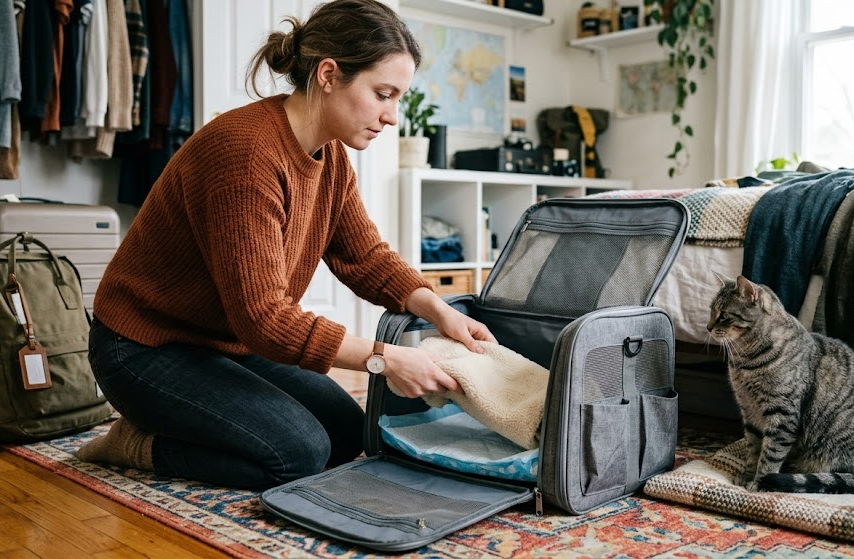
- Add an absorbent pad or thin familiar blanket
- Attach an ID tag with your phone number and destination information
- Confirm all zippers close fully and cannot pop open easily
- Pack a small collapsible bowl and any required medication
- Keep printed or saved airline pet-policy details available
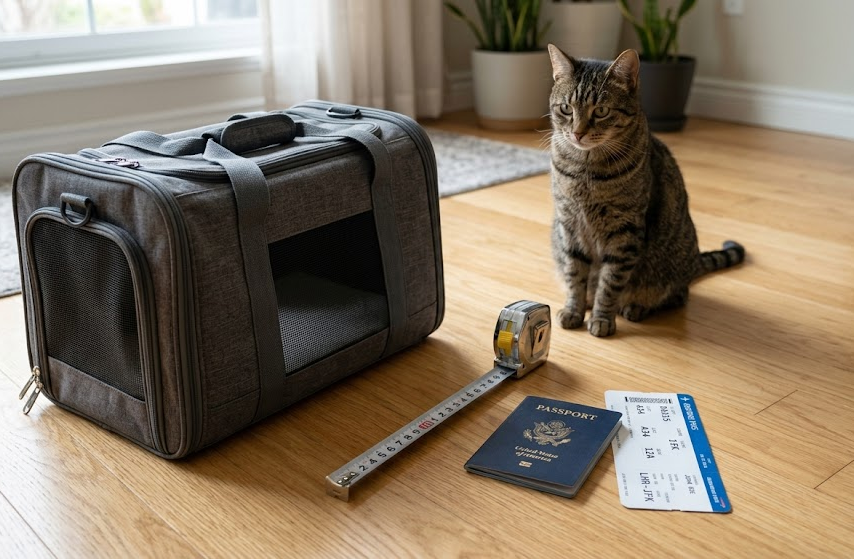
How to Measure the Carrier Correctly
Many travelers get tripped up because they measure the wrong part of the carrier. Airlines usually care about the carrier’s exterior dimensions, because that determines whether it can fit beneath the seat.
Step 1: Set the Carrier Up Fully
Zip the carrier closed, insert any base support it normally uses, and place it on a flat floor. Measure it in the same condition you would use on travel day. If a soft-sided carrier expands outward when filled, measure it with realistic packing inside.
Step 2: Measure Exterior Length, Width, and Height
Use a flexible tape measure and record the longest, widest, and tallest points.
- Length: front edge to back edge
- Width: side to side at the widest point
- Height: floor to highest top point
This is where mistakes happen. A soft-sided carrier may look compliant at the rigid base but exceed the limit once the sides puff outward. A handle or reinforced seam can also add height.
Step 3: Compare Against the Airline’s Under-Seat Limit
An airline-approved cat carrier is only "approved" if it works for your airline, aircraft, and route. One airline may accept a slightly taller soft carrier because it can compress under the seat, while another may publish stricter dimensions or require a specific style.
A useful way to compare is to create a simple note like this:
- Airline max size: 18 x 11 x 11 inches
- Your carrier size: 17.5 x 10.5 x 10.5 inches
- Result: fits with a small margin
Do not rely on a product label that says "airline approved" without checking the actual numbers.
How to Measure Your Cat for Travel Comfort
Carrier dimensions matter because they affect your cat’s comfort, not just compliance. A cat carrier that technically fits under the seat can still be a poor choice if your cat cannot reposition normally.
Step 1: Measure Body Length
Measure from the tip of the nose to the base of the tail, not all the way to the tail tip. This gives you the cat size that matters for usable floor space.
Step 2: Measure Standing Height
Measure from the floor to the top of the shoulders or the top of the head, depending on how your cat naturally stands. This helps you judge whether the carrier gives enough vertical room.
Step 3: Check Real Movement Inside the Carrier
After the tape-measure step, do a real-world fit test.
Your cat should be able to:
- stand without being pressed flat
- turn around with some ease
- lie down in a natural curled or stretched resting position
- settle without constant contact against every wall
If your cat is between sizes, the better answer is usually to compare airlines or carrier designs early, not to force a too-small carrier on travel day.
What to Confirm With Your Airline Before Departure
The airline policy is part of the measurement process. Carrier dimensions and airline policy are linked: even a well-sized carrier can fail if the route, aircraft, or pet rules differ from your assumptions.
Confirm These Details Before You Fly
- Maximum in-cabin pet carrier dimensions
- Whether the dimensions refer to hard-sided or soft-sided carriers differently
- Combined pet-and-carrier weight limits, if applicable
- Fees for in-cabin pets
- Whether your specific route or aircraft allows cabin pets
- Check-in timing requirements for travelers with pets
- Required health documentation for your destination
Why This Matters
Airline policy changes the decision, not just the product. A soft-sided carrier may work well because it can flex slightly under the seat, but only if the airline allows that kind of fit. Your cat size also changes the decision, because a carrier that meets the policy may still be too cramped for your individual pet.
Packing and Labeling Tips
A good cat travel checklist includes small details that prevent messy surprises at security and boarding.
Smart Packing Choices
- Use a thin absorbent liner instead of a bulky bed that steals interior space
- Pack one familiar-smelling item to reduce stress
- Keep treats accessible, but avoid overfeeding before the flight
- Bring a spare pad in case of an accident or spill
- Trim your cat’s nails in advance if scratching the mesh is a concern
Label the Carrier Properly
Include:
- your name
- mobile number
- destination city
- emergency contact
- your cat’s name
A secure ID label helps if the carrier needs to be handled separately during screening or if travel plans change unexpectedly.
Last-Minute Mistakes to Avoid at the Airport
Even travelers who know airline cat carrier requirements can run into trouble if they leave the real checks too late.
Common Mistakes
- Measuring only the product listing dimensions and not the actual packed carrier
- Checking the carrier size but forgetting the airline’s weight rule
- Assuming every aircraft on the route has the same under-seat clearance
- Using thick bedding that reduces usable interior room
- Testing the carrier for the first time on departure day
- Forgetting to confirm reservation space for the pet, if the airline limits cabin pets per flight
A Better Final Check
The night before your flight, do one complete test:
- Set up the full carrier as it will be used.
- Measure the outside dimensions again.
- Place your cat inside for a calm fit check.
- Verify documents, labels, liner, and closures.
- Review the airline policy one last time.
That five-minute review can prevent a stressful gate-side surprise.
FAQ
What measurements matter most for an airline-approved cat carrier?
The most important measurements are the carrier’s exterior length, width, and height, plus your cat’s body length, standing height, and weight. Those numbers tell you whether the carrier fits the airline’s cabin rules and whether your cat fits the carrier comfortably.
Should I measure the inside or outside of the carrier?
Measure both, but use them for different decisions. The outside determines whether the carrier fits the airline’s under-seat rules. The inside helps you judge whether your cat can stand, turn, and lie down comfortably.
What should I confirm with the airline before the flight?
Confirm the maximum carrier dimensions, whether soft-sided carriers can compress, the in-cabin pet fee, any pet-and-carrier weight limit, route restrictions, and required check-in or documentation rules.
Final Checklist Before You Head to the Airport
Before you walk out the door, make sure:
- the carrier dimensions match your airline policy
- your cat fits comfortably inside
- the zippers and mesh are secure
- the liner is in place
- your identification label is attached
- your reservation and documents are confirmed
When you handle those checks early, flying with a cat becomes much more predictable — and much less stressful for both of you.


Leave a Reply