


Cat Water Fountain Filter Replacement: How Often Should You Change It?
Most cat water fountain filters should be changed about every 2 to 4 weeks, but the right schedule depends on how many pets use the fountain, your water quality, and whether the filter is already trapping odor, hair, or visible debris. If the fountain is used by multiple cats or your tap water is hard, you may need to replace the filter sooner.
That is the short answer, but the useful answer is more specific. A cat water fountain filter replacement schedule is not really about the calendar alone. It is about how quickly the filter is getting clogged, how well it is still controlling odor and sediment, and whether the fountain is still circulating clean water the way it should.
If you have been wondering how often change cat water fountain filter parts without wasting money or waiting too long, think in terms of baseline schedule plus warning signs. Start with the normal replacement window, then adjust based on your home, your pets, and the way the fountain is actually performing.
Quick answer: typical filter replacement timeline
For most homes, this is a practical starting point:
- Every 2 weeks: best for multi-cat households, heavy shedding, dusty environments, or hard water
- Every 3 weeks: a strong middle-ground schedule for many single-cat homes with steady use
- Every 4 weeks: sometimes reasonable for lighter use, cleaner water, and consistent fountain cleaning
A simple rule of thumb is this: if the fountain is seeing daily use, the filter replacement schedule should usually stay inside that 2-to-4-week range even when the filter does not look terrible yet.
Maintenance schedule by situation
| Situation | Better starting schedule | Why it changes the timing |
|---|---|---|
| One cat, softer water, regular cleaning | Every 3 to 4 weeks | Lower debris load and slower buildup |
| One cat, hard water or dusty home | Every 2 to 3 weeks | Minerals and fine particles clog faster |
| Two or more cats using one fountain | Every 2 weeks | More saliva, fur, and daily circulation volume |
| Long-haired cats or heavy shedders | Every 2 weeks | Hair and dander shorten filter life |
| Irregular fountain cleaning | Sooner than normal | A dirty fountain makes the filter work harder |
The key relationship is simple: more pets, dirtier water, and weaker cleaning habits all shorten filter life. That is why one household can get almost a month from a filter while another should replace it much earlier.
What changes the replacement schedule
Number of pets using the fountain
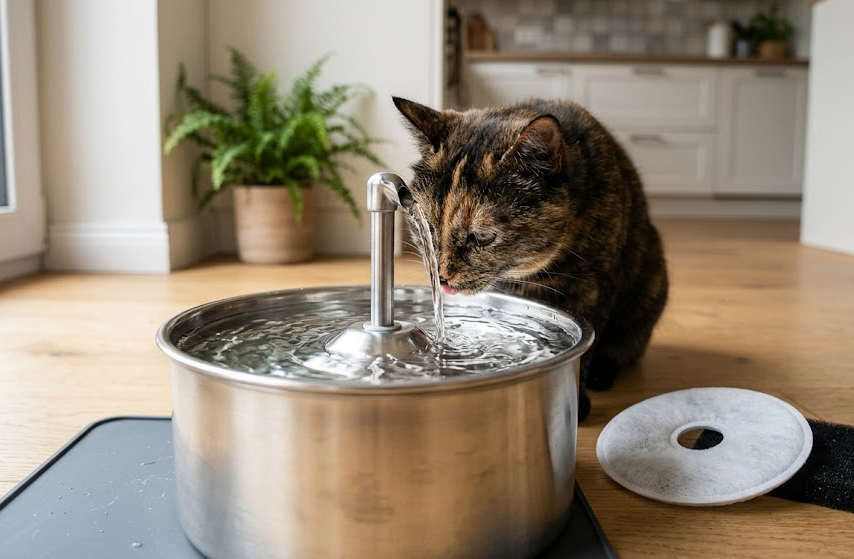
Multi-pet use is one of the biggest reasons a filter needs to be replaced sooner. More cats drinking from the same fountain means more fur, saliva, food residue around the mouth area, and more total water movement through the system. In plain English, multi-pet use increases filter workload.
Water quality in your home
Water quality matters more than many owners expect. Hard water can leave mineral buildup that makes the fountain and filter seem dirty faster, even when the bowl itself still looks acceptable. If your water leaves scale on kettles, faucets, or coffee machines, it may also shorten the life of a cat water fountain filter.
How often you clean the fountain itself
A fresh filter does not compensate for a neglected fountain. If the pump housing, basin, and spout are slimy or full of trapped hair, the filter has to work in a dirtier system. Clean parts help the filter last closer to its normal range. Dirty parts push it toward earlier cat water fountain filters replacement.
Type of filter your fountain uses
Some fountains use a single carbon filter. Others add a foam pre-filter around the pump. Some filter designs are thin and basic, while others have more media and hold up a little better between changes. The manufacturer instructions still matter, but real-world use should override wishful thinking.
Signs a fountain filter needs replacing sooner
Do not wait only for the calendar if the fountain is already telling you the filter is spent.
Water flow looks weaker
If the stream is weaker than usual after basic cleaning, the filter may be loaded with debris. Reduced flow is one of the most common practical signs that replacement is overdue.
The water or fountain starts to smell off
A filter that is no longer doing much odor control should not stay in service just because it has not hit the end of the month yet. If the fountain smells stale, musty, or generally less fresh, replace the filter and clean the unit.
The filter looks discolored or slimy
A little discoloration is normal over time. Heavy staining, trapped sludge, or a slimy feel means the filter is past the point where a rinse alone is a good answer.
Your cat seems less interested in the fountain
Cats can be annoyingly honest about water quality. If your cat suddenly drinks less from the fountain while still drinking elsewhere, stale water taste, odor, or reduced flow could be part of the problem.
Debris shows up soon after cleaning
If hair, dust, or particles reappear quickly and the water looks less clear even after a normal wash, the filter may no longer be doing enough.
How to replace the filter correctly
If you want better performance, not just a box checked off on the calendar, replace the filter the right way.
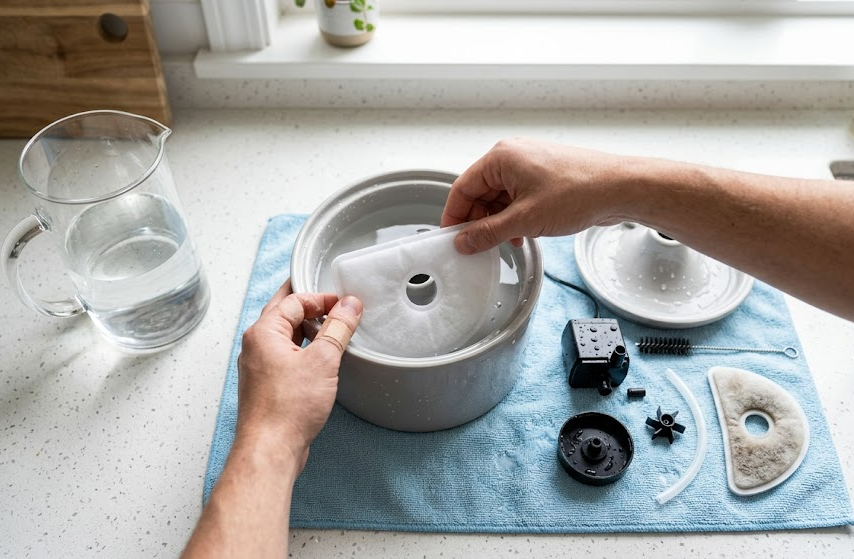
Step-by-step filter replacement
- Unplug the fountain. Never take the unit apart while it is running.
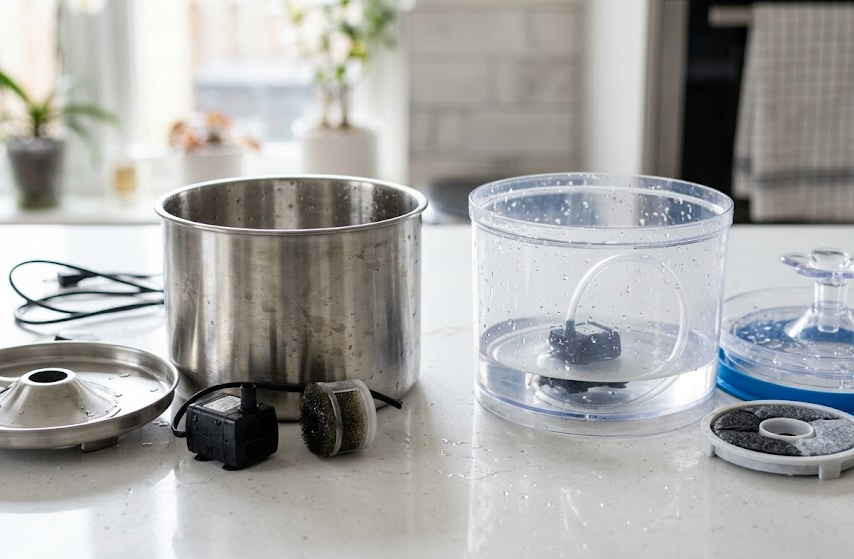
- Disassemble the fountain. Remove the tank, lid, and pump parts according to your model.
- Remove the old filter. Check for trapped hair, slime, or mineral deposits while you are there.
- Rinse the new filter if the manufacturer recommends it. Many carbon filters need a brief rinse to remove loose carbon dust before installation.
- Install the new filter in the correct direction. If your model has an up/down or front/back orientation, pay attention here because cat fountain filter direction mistakes can reduce performance.
- Clean the fountain parts before reassembly. Do not put a clean filter into a dirty fountain.
- Refill with fresh water and restart the unit. Make sure the pump is flowing normally.
If you need replacement parts, a real on-site option like these cat water fountain replacement filters fits naturally when you already know your current fountain uses standard activated-carbon style filter sets and you want to keep maintenance simple.
Common mistakes that shorten filter life
Replacing the filter but not cleaning the pump
This is probably the most common mistake. A dirty pump pushes grime back into the system and makes the new filter seem ineffective much faster.
Waiting for obvious failure
Some people wait until the fountain is visibly gross or the flow is almost gone. That is too late. A better habit is replacing the filter while performance is still acceptable but clearly trending downward.
Assuming rinsing equals full reuse
Some filters can be lightly rinsed as part of routine upkeep, but that is not the same as making them new again. Rinsing may buy a little time in the short term, but it does not fully restore filtration media that is already saturated.
Ignoring hard water buildup
If your home has mineral-heavy water, the filter may not be the only issue. Scale around the pump and fountain channels can make you think the filter failed faster than it really did. In practice, both cleaning and replacement matter.
Simple maintenance calendar
A practical routine looks like this:
- Daily: top off water and check that flow looks normal
- Every few days: remove visible hair or debris from the bowl area
- Weekly: rinse accessible parts and inspect the pump intake
- Every 2 to 4 weeks: replace the filter based on your household conditions
- On a deeper cleaning day: fully wash the basin, pump parts, and channels before installing a fresh filter
This kind of rhythm works better than treating filter changes as a random chore. When the maintenance is predictable, the fountain stays more appealing to your cat and easier to manage for you.
Can you rinse and reuse a cat fountain filter?
Sometimes you can gently rinse a filter as a short-term maintenance step, but you should not treat that as a permanent substitute for replacement. Once the media is loaded with trapped particles and odor, rinsing only does so much. If you are debating whether to squeeze more life out of an old filter, that is usually a sign the replacement window is already close.
FAQ
How often should you replace a cat water fountain filter?
For most households, every 2 to 4 weeks is a reasonable starting schedule. Heavier use, hard water, and multiple cats often push that closer to every 2 weeks.
What happens if you do not change the filter?
Water flow can weaken, odor control can drop, debris can build up faster, and the fountain may become less appealing to your cat. The system can also get harder to clean if buildup keeps accumulating.
Can you rinse and reuse a cat fountain filter?
You can sometimes rinse it lightly, depending on the filter type, but that is not the same as restoring full performance. A rinsed filter should usually be treated as a temporary extension, not a true reset.
Final takeaway
If you are asking how often should you change a cat water fountain filter, the practical answer is usually every 2 to 4 weeks, with earlier replacement for hard water, heavy shedding, or multi-cat use. The best habit is to follow a baseline schedule, watch for weaker flow and odor, and replace the filter before performance falls off a cliff.
Leave a Reply