


Automatic Cat Feeder for Wet Food: What to Check Before You Buy
Before buying an automatic cat feeder for wet food, check how it keeps food fresh, how many meals it can schedule, how easy it is to clean, and whether it fits your cat household setup. Those four points matter more than app features or marketing claims, because wet food creates a different set of problems than dry kibble: spoilage, mess, cooling limits, and uneven portions when more than one cat is involved.
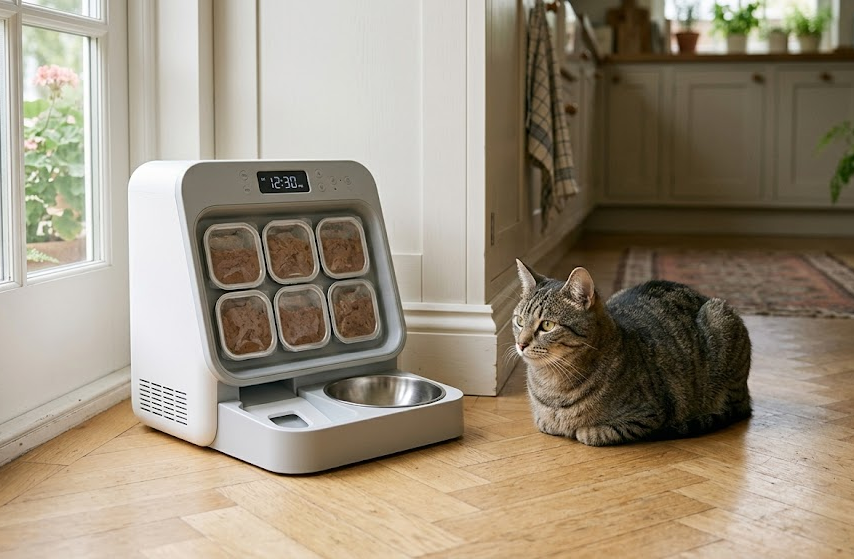
A wet cat food feeder can be a smart buy if you need better meal timing, portion control, or help feeding early-morning meals. But not every automatic pet feeder for wet food solves the same problem. Some are best for short daytime gaps, while others are better for households that need multiple small meals, separate feeding access, or extra freshness protection.
If you are comparing the best automatic cat feeder for wet food, focus less on “smart” branding and more on these buyer checks: cooling method, tray style, meal count, cleaning effort, and whether one cat can steal another cat’s portion.
Quick answer: when a wet-food feeder is worth buying
An automatic wet food cat feeder is worth buying when you need to serve wet meals on a schedule and you cannot always be at the bowl at the right time. It is especially useful for cats that wake you early for breakfast, need smaller meals through the day, or do better with portioned feeding rather than free feeding.
It is usually a good fit when:
- your cat eats wet food reliably on a schedule
- you want to split food into smaller meals instead of one or two large servings
- you need coverage for work hours, mornings, or short absences
- you can realistically clean the tray and food-contact parts often
It is a weaker fit when:
- you need wet food held fresh for long periods without adequate cooling
- one cat regularly steals food from another
- your cat is very sensitive to texture changes after food sits out
- you want a low-maintenance feeder but do not want to wash trays frequently
Feature comparison table: what matters most before you buy
| Buying factor | What to check | Why it matters for wet food |
|---|---|---|
| Cooling method | Ice packs, chilled base, insulated tray, or no cooling | Wet food spoils faster than dry food once it sits out |
| Meal count | Number of compartments or scheduled openings | More meal slots help if your cat eats several small portions |
| Tray design | Sealed lid, rotating tray, flip-lid compartment, stainless insert | Tray shape affects freshness, mess, and cleanup speed |
| Portion size | Real compartment capacity, not vague “meal” claims | Wet food volume varies a lot by brand and serving plan |
| Cleaning effort | Dishwasher-safe parts, removable tray, smooth corners | Wet food residue builds up fast and can become unpleasant quickly |
| Household fit | Single-cat use, two-cat access, microchip/RFID control, placement flexibility | Multi-cat homes often have fairness problems, not just timing problems |
Cooling and freshness considerations
Freshness is the first thing to check because it is the biggest difference between a dry feeder and a wet cat food feeder. A standard dry-food hopper is designed to hold food for days. Wet food is not. Once exposed, it starts losing temperature control and can dry out, smell stronger, or become less appealing.
What “cooling” really means in these feeders
Most wet-food automatic feeders do not refrigerate like a mini fridge. Instead, they usually rely on one of these approaches:
- an ice pack under or around the tray
- an insulated compartment area
- a lid system that keeps unopened portions covered until mealtime
- a short holding window where freshness is acceptable for a few hours rather than all day
That means you should not buy based on a vague promise that food stays “fresh.” You want to know how it stays fresh, for how long, and under what room conditions.
Questions to ask before buying
- Does the feeder use replaceable ice packs?
- How long is the brand realistically expecting wet food to sit before opening?
- Are unopened portions covered well enough to slow drying?
- Can the tray go back in the fridge before use if you prep meals ahead?
- Will your room temperature make the feeder work harder than average?
If you need something for a long hot day, the feeder’s cooling design matters much more than app control.
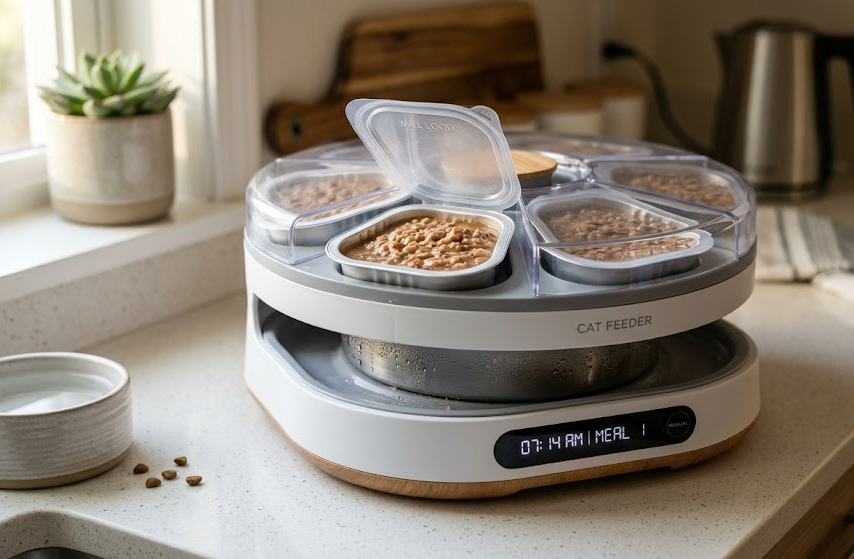
Portion scheduling and meal count
Meal scheduling is the second major decision point. Some feeders open one compartment at a time on a timer. Others rotate through multiple tray sections. The practical question is simple: does the feeder match how your cat actually eats?
Why meal count matters more for wet food cats
Cats that eat wet food often do better with smaller meals spread through the day. If you only get one or two usable servings before the tray is empty, the feeder may not actually solve your routine problem.
Look for:
- enough compartments for your normal day
- scheduling that lets you set exact meal times, not just rough intervals
- portion sections large enough for your cat’s real serving size
- tray openings that expose only the next meal instead of leaving all food uncovered
A feeder with more meals is not automatically better, but a feeder with too few scheduled openings can become annoying fast.
Watch for “portion” language that is too vague
Some automatic cat feeder wet food reviews use “portion control” loosely. For wet food, portion accuracy depends on compartment size, food texture, and whether you are feeding pate, chunks, or mixed toppers. One “portion” in marketing language may not match one meal for your cat.
Single-cat vs multi-cat household fit
This is where many buyers make the wrong choice. They assume the best automatic cat feeder for wet food is simply the one with the best timer. In reality, household setup matters just as much.
Single-cat homes
For one cat, the main questions are freshness, number of meals, and cleaning effort. If your cat already eats wet meals calmly and on schedule, a basic timed tray feeder may be enough.
Multi-cat homes
In two-cat homes, the risk is often not timing. It is access. If one cat reaches the feeder first, that cat may eat both servings. That makes some wet-food feeders look good in theory but frustrating in real use.
A two-cat wet-food setup works best when:
- both cats eat similar food
- both cats finish at a similar pace
- neither cat guards the bowl
- feeder placement allows some separation
If one cat steals food, eats faster, or needs a different diet, the better answer may be protected access rather than a standard shared feeder. In that kind of case, an automatic pet feeder with collar sensor for multi-pet feeding is often a closer fit to the real problem, because controlled access matters more than a simple timer.
Cleaning, tray design, and food safety
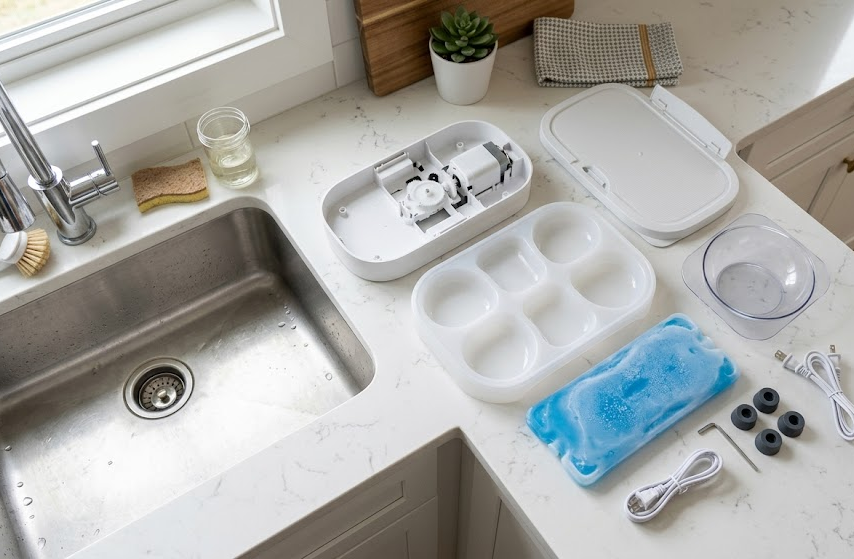
The best automatic cat feeder for wet food is the one you will realistically keep clean. Wet food leaves oils, residue, and odor faster than dry kibble, so tray design matters a lot.
What makes tray design easier to live with
Look for:
- smooth surfaces without hard-to-reach corners
- removable food trays
- lids or covers that wipe down easily
- stainless steel or food-safe inserts when available
- dishwasher-safe parts for the main food-contact pieces
Signs a feeder may be annoying in daily use
Be cautious if:
- the tray has tight corners where residue can build up
- the lid mechanism is hard to open for washing
- food-contact parts are not clearly removable
- replacement trays or ice packs are hard to find
- user reviews repeatedly mention smells, sticking lids, or difficult cleanup
Food safety in wet-food feeders is less about gadget complexity and more about realistic hygiene. If the feeder is hard to wash, many owners clean it less often than they should.
Pre-buy checklist
Before you buy an automatic pet feeder for wet food, run through this checklist:
- Freshness: What exact cooling or covering system does it use?
- Timing: How many meals can it actually schedule in one day?
- Capacity: Does each compartment fit your cat’s normal wet-food serving?
- Cleaning: Can you remove and wash the tray easily?
- Household fit: Is it for one cat, or can another cat steal the meal?
- Placement: Will it sit in a cool, low-conflict feeding spot?
- Routine: Are you willing to prep trays and ice packs regularly?
If a feeder looks good on paper but fails on freshness, cleaning, or access control, it is usually the wrong buy for wet food.
Who should buy one and who should skip it
A wet-food automatic feeder is usually a strong buy for:
- owners who feed wet meals on a regular schedule
- cats that do better with multiple small portions
- households that need help with early-morning or midday feeding
- owners who do not mind routine tray cleaning and prep
It is often a poor fit for:
- homes where wet food would need to sit out too long for the feeder’s cooling design
- households with strong food stealing and no access control
- people who want a “fill it and forget it” system like a dry-food hopper
FAQ
Can automatic feeders handle wet cat food safely?
Yes, some can handle wet cat food safely, but only when the feeder is designed for wet meals and you use it within its realistic freshness window. Cooling method, covered compartments, room temperature, and cleaning routine all matter.
How long can wet food stay in an automatic feeder?
That depends on the feeder’s design, room temperature, and whether it uses ice packs or another cooling method. In general, you should be skeptical of long hold times unless the freshness system is clearly explained and practical for your routine.
Are wet-food feeders good for two cats?
They can be, but only if both cats share food well. If one cat eats faster, steals meals, or needs a different diet, a standard shared feeder often becomes frustrating. In those cases, controlled-access feeding is usually the better setup.
Final takeaway
If you are shopping for the best automatic cat feeder for wet food, the smart move is to buy for freshness, meal structure, and household behavior—not just convenience features. Check how the feeder keeps food fresh, how many meals it can schedule, how easy it is to clean, and whether your cat setup needs simple timing or true access control.
That is the difference between a wet-food feeder that helps and one that ends up becoming an expensive plastic tray in the cabinet.
Leave a Reply