


Slow Feeder Dog Bowl vs Slow Feeder Insert: Which Is Better for Fast Eaters?
A full slow feeder bowl is usually better when you want stability and a purpose-built eating surface, while a slow feeder insert is better when you want to reuse an existing bowl and need more flexibility. For most fast eaters who slide dishes around or eat a mix of kibble and wet food, the better choice comes down to bowl fit, cleaning tolerance, and how much movement your dog creates during meals.
If you want the shortest version: choose a slow feeder bowl when you want the most secure setup, and choose a slow feeder insert when you already own a bowl you like and want a lower-commitment way to slow your dog down.
Quick Answer: When a Bowl Is Better and When an Insert Is Better
A slow feeder dog bowl is usually the better pick when:
- your dog pushes dishes around the floor
- you want one-piece simplicity
- you mainly feed dry food or mixed meals
- you do not want to guess whether an insert will fit your current bowl
A slow feeder insert is usually the better pick when:
- you already have a bowl that fits your dog well
- you want to test slow feeding without replacing everything
- you switch between stainless steel, ceramic, or travel bowls
- you need more flexibility than a fixed bowl shape gives you
The biggest relationship to understand is simple: better bowl fit leads to better slowing effect, and poor fit leads to slipping, gaps, and easier gulping. That is why inserts can be excellent in the right bowl but frustrating in the wrong one.
Side-by-Side Comparison Table
| Feature | Slow feeder bowl | Slow feeder insert |
|---|---|---|
| Stability | Usually stronger because the maze is built into the bowl | Depends on suction, material, and bowl surface |
| Bowl fit | No compatibility guessing | Must match the width and inner shape of your existing bowl |
| Cleaning | One piece, usually simpler | Extra part to remove and scrub around |
| Dry food use | Usually excellent | Usually very good if the fit is secure |
| Wet food use | Usually better for messy eaters | Can work well, but creases and suction areas may hold residue |
| Travel or reuse | Less flexible | More flexible if you use several bowls |
| Best for | Dogs that shove bowls, strong eaters, owners who want less fuss | Owners who want to reuse bowls or test slow feeding first |
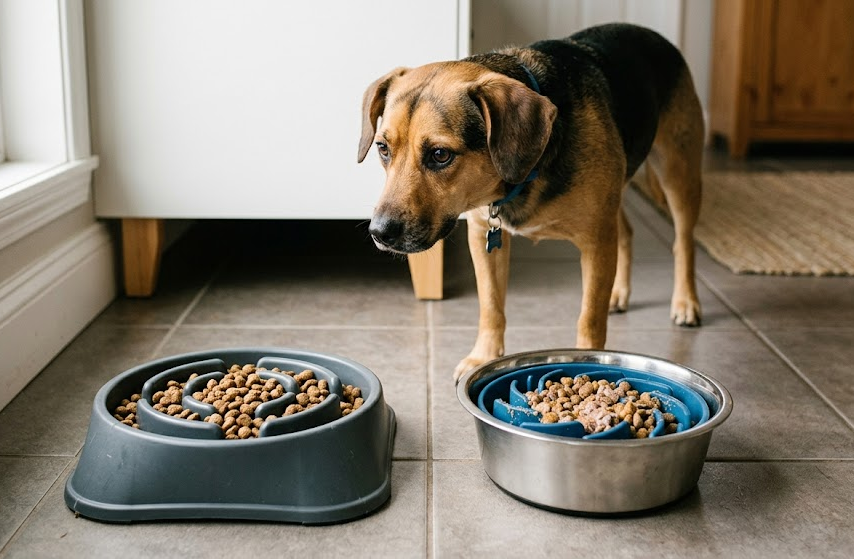
How Each Option Works for Fast Eaters
Both products aim to do the same job: make your fast eater work around ridges, pockets, or maze patterns instead of inhaling food in a few bites. Slower eating can help reduce gulping, belching, and post-meal discomfort, and it often turns meals into a more mentally engaging activity.
The difference is in the structure.
How a slow feeder bowl works
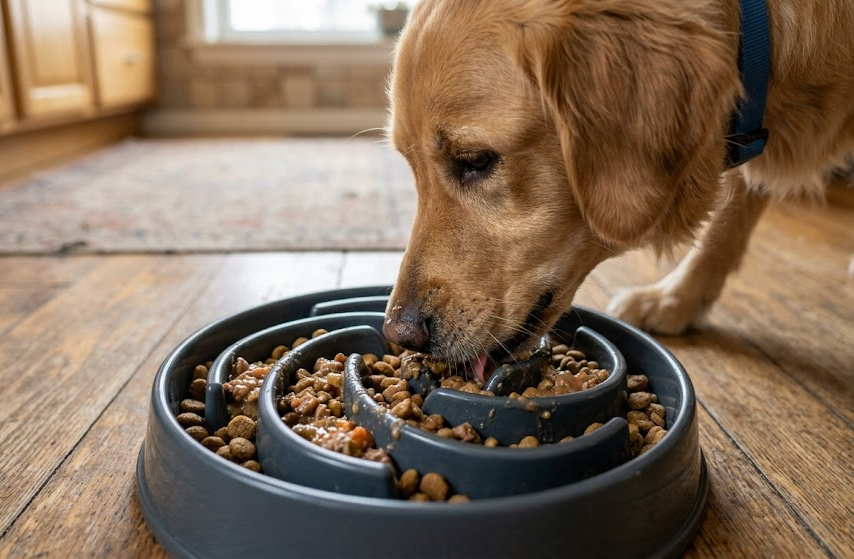
A slow feeder bowl has the obstacles built directly into the base. Because the eating surface is purpose-built, the pattern is usually deeper and more stable. That matters for a fast eater dog because stability changes behavior: when the dish stays in place, your dog has to interact with the maze instead of lifting, flipping, or bypassing it.
If your dog is energetic at mealtime, a purpose-built bowl often gives a cleaner, more predictable result. A good example is a non-slip slow feeder bowl for dogs, which fits the “just give me a stable feeding surface” use case better than a removable add-on.
How a slow feeder insert works
A slow feeder insert is usually silicone or flexible plastic that attaches inside another bowl. The advantage is flexibility: instead of buying a whole new bowl, you turn a bowl you already own into a slower feeder.
That convenience is exactly why inserts are attractive, but it also creates the main weakness. An insert only works as well as the bowl underneath it. If the bowl walls are too steep, too wide, too narrow, or too textured for suction, the insert may shift. Once it shifts, the slowing effect drops fast.
Fit and Compatibility With Existing Bowls
Compatibility is where most owners either love inserts or give up on them.
A slow feeder bowl removes the guesswork. You buy one feeding surface, set it down, and use it. You do not need to check bowl diameter, inner curvature, or whether the base is smooth enough for suction.
An insert asks more from your setup:
- the bowl needs enough interior width for the insert to lie flat
- the bowl surface needs enough smooth contact for suction cups to hold
- the rim and wall shape should not create lift points
- the insert height should still leave room for food without spilling
Do inserts work in stainless steel bowls?
Often yes, but only when the interior is smooth and the dimensions are a good match. Stainless steel can actually be a strong pairing for a silicone slow feeder insert because the suction cups have a smoother surface to grip than rough ceramic glaze. The catch is size. If the insert is too small, it will float around. If it is too large, it may buckle upward.
When bowl shape changes the recommendation
- Wide, shallow bowl: inserts can work very well
- Tall, narrow bowl: inserts are harder to seat properly
- Heavy ceramic bowl: good weight, but suction depends on the glaze finish
- Standard purpose-built slow feeder bowl: usually the easiest no-fuss option
For owners who do not want to measure or experiment, the bowl wins on convenience. For owners who already know their existing bowl dimensions and want to reuse what they own, the insert can make more economic sense.
Cleaning, Durability, and Slipping Concerns
This is one of the least glamorous decision points, but it matters every single day.
Cleaning
A slow feeder bowl is usually easier to clean because it is one item. You still have to scrub around the ridges, but there is no second layer trapped against another bowl.
An insert adds another surface. Wet food compatibility is possible, but wet food also makes cleanup more annoying because residue can collect around the underside, suction cups, and edges. If you feed canned food, fresh food, or soaked kibble often, that extra cleanup becomes more noticeable over time.
Durability
A solid bowl usually keeps its shape better over time. A silicone slow feeder insert is flexible by design, which is good for fit but not always ideal if your dog paws at the bowl, chews removable parts, or pries the insert loose after meals.
Slipping and movement
This is the biggest buyer hesitation, and it is valid.
A full bowl is usually better when your dog lunges into meals, because the product weight and integrated base reduce shifting. Inserts are more sensitive to surface conditions:
- water under the suction cups weakens grip
- textured bowls reduce hold
- strong noses can pry edges loose
- repeated dishwasher wear may eventually affect shape in some low-quality inserts
Which Option Works Better for Dry Food, Wet Food, and Mixed Meals
Meal type changes the recommendation more than many people expect.
Dry food
Both options can work very well for dry kibble. If the insert is fitted correctly, kibble usually stays distributed across the pattern and still slows eating.
Wet food
A slow feeder bowl usually has the edge here. Wet food compatibility depends on how easy the pattern is to lick clean and whether the product stays fully seated. Inserts can still work, but soft food tends to expose any movement, edge lift, or awkward cleaning areas.
Mixed meals
For mixed meals, many owners still prefer a full bowl because it combines stability with easier cleanup. If you regularly serve toppers, broth, soaked kibble, or fresh add-ins, a stable bowl often feels less messy and less fussy.
Pros and Cons
Slow feeder bowl pros
- purpose-built and usually more stable
- no compatibility guessing
- often easier for wet food and mixed meals
- better for strong, pushy, enthusiastic eaters
Slow feeder bowl cons
- less flexible if you already own bowls you like
- takes up extra storage compared with a removable insert
- may cost more upfront than a simple insert
Slow feeder insert pros
- lets you reuse an existing bowl
- flexible for stainless steel, ceramic, or travel setups
- lower-commitment way to test slow feeding
- easy to swap between bowls when the fit is right
Slow feeder insert cons
- fit problems can ruin performance
- suction and slipping vary by bowl surface
- extra cleanup step
- not ideal for dogs that pick at removable parts
Who Should Buy Each Style
Choose a slow feeder bowl if:
- your dog is a determined fast eater
- you feed wet food or mixed meals often
- you want the most stable setup with the least guesswork
- you would rather buy once than troubleshoot fit
Choose a slow feeder insert if:
- you already own a bowl that your dog uses comfortably
- you want to reuse a stainless steel or ceramic bowl
- you mostly feed dry food
- you are comfortable checking diameter, suction, and overall fit
Summary Takeaway
If you want the safer all-around recommendation for most fast eaters, buy the slow feeder bowl. If you want flexibility and already have a compatible bowl, a slow feeder insert can work extremely well, but only when the fit is secure and the surface supports it.
The real decision is not bowl versus insert in the abstract. It is stability versus flexibility. For messy, forceful, or highly food-driven dogs, stability usually wins. For owners with a good existing bowl and a lighter-touch eater, flexibility can be worth it.
FAQ
Do slow feeder inserts work in stainless steel bowls?
Yes, they often do, especially when the bowl interior is smooth. The important part is matching the insert size to the bowl so it sits flat and does not shift.
Are slow feeder inserts good for wet food?
They can be, but they are usually less forgiving than a full slow feeder bowl. Wet food makes movement and cleanup issues more obvious, so inserts work best when the fit is very secure.
Which is easier to clean: a slow feeder bowl or insert?
A slow feeder bowl is usually easier to clean because it is a single piece. Inserts add another layer, and the underside or suction areas can trap residue.
Final Verdict
For the average fast eater dog, a slow feeder bowl is better because it gives you a purpose-built eating surface, stronger stability, and fewer compatibility headaches. A slow feeder insert is better when you specifically want to reuse an existing bowl and are confident the fit is right.
Leave a Reply