


How to Stop One Pet From Stealing Food From an Automatic Feeder
If one pet keeps stealing food from an automatic feeder, the fix is usually to separate feeding access, change placement, or switch to a feeder that controls which pet can eat. In most multi-pet households, the problem is not that the feeder is “bad” — it is that the feeding setup does not match the pets’ speed, confidence, or diet needs.
Food stealing around an automatic feeder is common in a multi-pet household, especially when one cat is faster, bolder, or simply more food-motivated than the other pet. The good news is that you can usually solve automatic feeder food stealing without creating more tension. The right answer depends on whether you are dealing with two cats, a cat and dog, or pets on different diets.
Quick answer: the fastest fixes that work
If you need to stop pet stealing food from an automatic feeder quickly, start here:
- Move the feeder to a spot where the timid pet can eat without being ambushed.
- Feed pets farther apart so one animal cannot monitor both bowls easily.
- Use scheduled portions instead of leaving food exposed for too long.
- Supervise a few meals and interrupt stealing calmly before it becomes a habit.
- If one cat eats other cat food from an automatic feeder every day, upgrade to two feeders or an RFID feeder solution.
- If pets eat different diets, do not rely on a shared bowl system for long-term management.
Summary takeaway: the best short-term fix is usually better placement and distance, while the best long-term fix is separate or access-controlled feeding.
Why food stealing happens with automatic feeders
Automatic feeders solve timing problems, but they do not automatically solve social feeding problems. One pet may steal because:
- they eat faster than the other pet
- they are more assertive around food
- the bowls are too close together
- food stays available long enough for a second pass
- one pet is bored and has learned the feeder schedule
- one pet is on a more appealing diet than the other
In a multi pet feeder problems scenario, the feeder often becomes a predictable opportunity. A confident pet learns that food appears at the same place and same time every day, so they can finish their own portion and then move to the other bowl.
This is especially common when:
- two cats share one feeding area
- a dog can physically reach a cat feeder
- one pet needs weight control food and the other does not
- a senior or shy pet eats more slowly
Simple setup changes to try first
Before buying a new feeder, test a few low-cost changes.
1. Increase distance between feeding stations
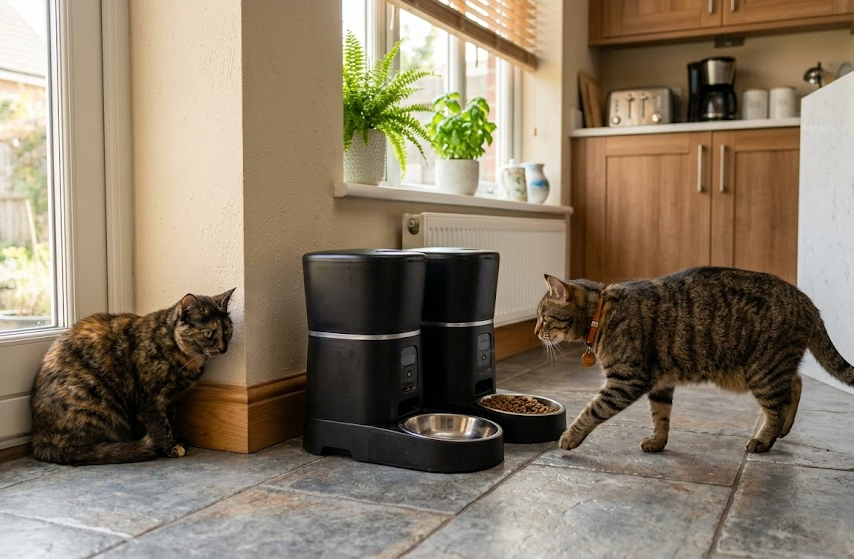
Many owners place both feeders side by side for convenience, but that makes it easy for one pet to patrol both bowls. Place feeders in different parts of the room or in different rooms if possible.
A useful starting point is to separate pet feeders far enough that one animal cannot comfortably guard both. In many homes, that means more than a few feet. If your bolder pet can see, hear, and reach the second feeder immediately, the setup is still too close.
2. Change the angle and visibility
Feeding station placement matters more than people expect. A shy pet often eats better when the bowl is:
- near a wall or corner for security
- away from hall traffic
- out of direct line of sight from the other pet
- not next to litter boxes, loud appliances, or doors
For a cat-and-dog household, elevation can help. A cat feeder on a sturdy counter-access route or inside a gated cat area may reduce stealing if the dog cannot reach it.
3. Reduce the time food sits exposed
If the bowl stays open too long, the fast eater has more chances to return. Try:
- smaller meals more often
- tighter meal windows
- removing leftovers when practical
- training both pets to approach the feeder promptly
4. Watch for body-language pressure
Food stealing is not always dramatic. Sometimes the slower pet backs away before the other animal even touches the bowl. If that is happening, the problem is not only speed. It is social pressure.
Problem-solution table
| Problem | Likely cause | Best fix |
|---|---|---|
| One cat finishes first and eats from both bowls | Feeders too close together; portions exposed too long | Separate feeding stations and shorten access time |
| Cat steals dog food from automatic feeder | Dog food is more reachable or more appealing | Raise or isolate the cat feeder, or feed in separate zones |
| Dog steals cat food from automatic feeder | Dog has physical access and stronger food drive | Use gates, elevation, or access-controlled feeders |
| Pets eat different diets | Shared feeding access is unsafe long term | Use two feeders or a microchip/RFID feeder |
| Shy pet leaves food untouched | Stress from the other pet’s presence | Move feeder to a protected, low-traffic area |
When you need separate or access-controlled feeders
Some households can be fixed with layout changes. Others need hardware changes.
You should strongly consider separate or access-controlled feeders when:
- one pet needs prescription food
- one pet is overweight and the other is not
- one pet grazes and the other bolts meals
- stealing continues after basic placement changes
- mealtime tension is making one pet anxious
Two automatic feeders
Do you need two automatic feeders for two pets? Often, yes. Two feeders let you control portions separately and place the stations far enough apart to reduce competition.
Two feeders work best when:
- both pets can eat on schedule
- both pets still have access to their own food reliably
- you can place the units in separate areas
- the issue is competition, not specialized diet access
Microchip or RFID feeder solution
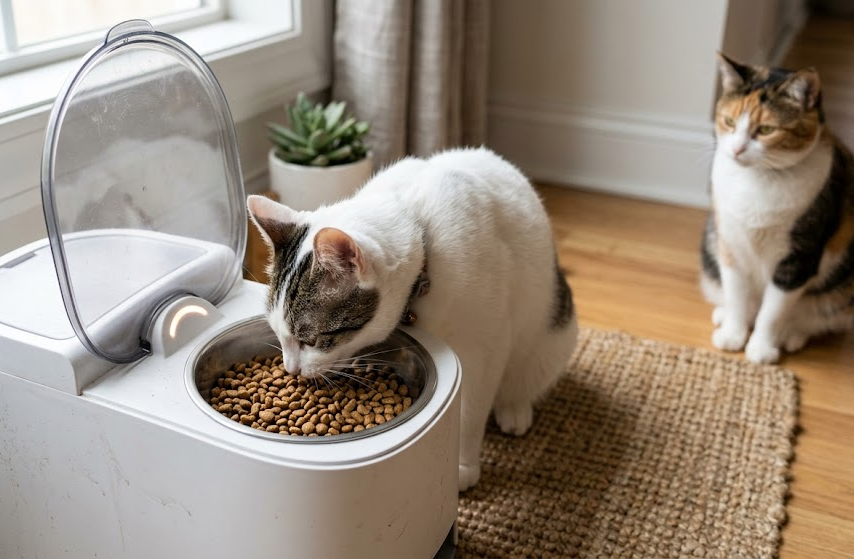
Can a microchip feeder stop food stealing? Yes, it can be one of the most effective solutions when the real problem is access. An RFID feeder solution opens only for the assigned pet, which is especially useful if one cat eats other cat food from an automatic feeder or when pets eat different diets.
Access-controlled feeders are worth it when:
- diet separation matters medically
- supervision is not realistic at every meal
- the stealing pet is persistent and clever
- the timid pet never gets a calm chance to eat
Best feeder features for homes with food competition
If you are replacing equipment, look for feeder features that solve the actual conflict instead of just adding convenience.
Separate scheduling and portion control
Independent programming helps when one pet needs smaller meals or slower pacing.
Covered or restricted bowl access
A more protected feeding area can reduce opportunistic stealing, especially between meal windows.
Reliable identification technology
For different diets, an RFID feeder or microchip-compatible design is usually more practical than trying to “train away” persistent food stealing.
Stable placement and low noise
A feeder that startles the timid pet can make stealing worse because the bolder pet adapts faster.
What to do if pets eat different diets
This is where many owners underestimate the risk. If one pet needs urinary food, kidney support food, weight management food, or allergy food, shared access is not just annoying — it can undermine the reason you bought the special diet.
For different diets:
- Give each pet a clearly separate feeding plan.
- Avoid leaving both foods openly accessible.
- Use physical separation first if it is enough.
- Move to a microchip or RFID feeder when consistency matters more than convenience.
- Track body weight and stool changes after the new setup.
If your household includes both a cat and dog, keep in mind that dogs often outcompete cats by speed and size. Even if the cat can technically reach the feeder, that does not mean the cat feels safe enough to use it.
Mistakes that make feeder sharing worse
These mistakes often keep the problem going:
- putting two bowls right next to each other
- assuming the slower pet will “learn to be faster”
- leaving food out long after the meal should be over
- punishing the stealing pet instead of changing access
- ignoring stress signals from the quieter pet
- using one feeding system for pets on different diets
The goal is not to create a perfect shared feeder situation if your pets clearly cannot share well. The goal is to build a feeding routine that is calm, repeatable, and safe.
Checklist: how to stop food stealing around automatic feeders
Use this checklist to troubleshoot your setup:
- Are feeders placed far enough apart?
- Can the timid pet eat without being watched or approached?
- Is food exposed for too long after dispensing?
- Are both pets on the same type of food?
- Is the issue occasional curiosity or daily access theft?
- Would two feeders solve the problem, or do you need selective access?
- Have you tested placement changes before replacing the feeder?
If you answer “no” to the first three questions, start there. If you answer “different diets” or “daily access theft,” a separate-feeding or RFID-based setup is usually the smarter long-term choice.
FAQ
Why does one cat keep eating from both feeder bowls?
Usually because the faster or more confident cat can finish first and still has easy access to the second bowl. Bowl placement, meal timing, and social pressure all matter.
Do I need two automatic feeders for two pets?
Not always, but two feeders are often the simplest fix when both pets need portion control and mealtime competition is the main issue.
Can a microchip feeder stop food stealing?
Yes. A microchip feeder can be the best answer when pets eat different diets or when one pet reliably steals food despite better placement and supervision.
How far apart should pet feeders be placed?
Far enough that one pet cannot comfortably monitor and reach both stations at once. In some homes, separate corners work. In others, separate rooms are better.
Conclusion
To stop pet stealing food from an automatic feeder, match the feeding setup to the pets’ behavior instead of expecting the pets to adapt to a flawed setup. Start with feeder placement, distance, and tighter meal windows. If stealing continues — especially in a multi-pet household with different diets — move to separate feeders or an RFID feeder solution. That usually solves the problem with less stress for everyone involved.
Leave a Reply