


Best Automatic Cat Feeder for Multiple Cats: What Actually Works?
If you’re trying to find the best automatic cat feeder for multiple cats, the short version is this: a basic shared timed feeder can work when your cats eat the same food, at roughly the same pace, and don’t steal from each other—but for many multi-cat homes, the setups that actually work best are either separate feeders or an RFID/microchip-style feeder that controls access by pet. That matters because the real problem usually is not just automation. It is portion control, food stealing, diet separation, and lowering mealtime tension.
For most households with two or more cats, the right choice depends on one question first: do your cats truly share food well, or does one cat dominate meals? Once you answer that, the best automatic feeder setup becomes much easier to pick.
Quick answer: what works best for most multi-cat homes
Here is the simplest way to think about it:
- **A shared automatic feeder works best** when your cats eat the same diet, have similar calorie needs, and do not bully each other away from the bowl.
- **Two separate automatic feeders work best** when both cats can use standard timed or app-controlled feeders, but portions need to stay more consistent.
- **An RFID or microchip cat feeder works best** when one cat steals food, one cat is on a prescription diet, or one cat grazes while the other cat inhales meals.
In other words, the best automatic feeder for multiple cats is usually the one that creates controlled access, not just scheduled food drops.
Comparison table: which feeder type fits your home?
| Feeder type | Best for | Main strength | Main weakness |
|---|---|---|---|
| Shared timed feeder | Two easygoing cats with the same food | Affordable and simple | One cat can eat both portions |
| Two separate timed feeders | Two cats with similar schedules but uneven appetites | Better portion accuracy per cat | Still needs physical separation |
| App-controlled feeder | Owners who want flexible scheduling and remote control | More precise timing and alerts | Does not stop food stealing by itself |
| RFID/microchip feeder | Cats on different diets or homes with food guarding | Restricts access to the right cat | Higher cost and training period |
| Split-bowl dual outlet feeder | Cats that eat side by side calmly | One machine, two portions | Not ideal for dominant cats |
When a shared feeder works vs. when separate feeders are better
A shared automatic cat feeder for two cats can work—but only in a fairly specific kind of household. If both cats are calm eaters, finish meals at about the same speed, and can safely eat the same kibble, a single feeder may be enough. This setup is usually the lowest-cost option and can reduce the hassle of manual feeding.
A shared setup starts to fail when any of these problems show up:
- one cat eats much faster than the other
- one cat is heavier and should be eating less
- one cat needs a different formula or prescription diet
- one cat guards the bowl or stalks the other during meals
- one cat likes to graze while the other treats feeding time like a race
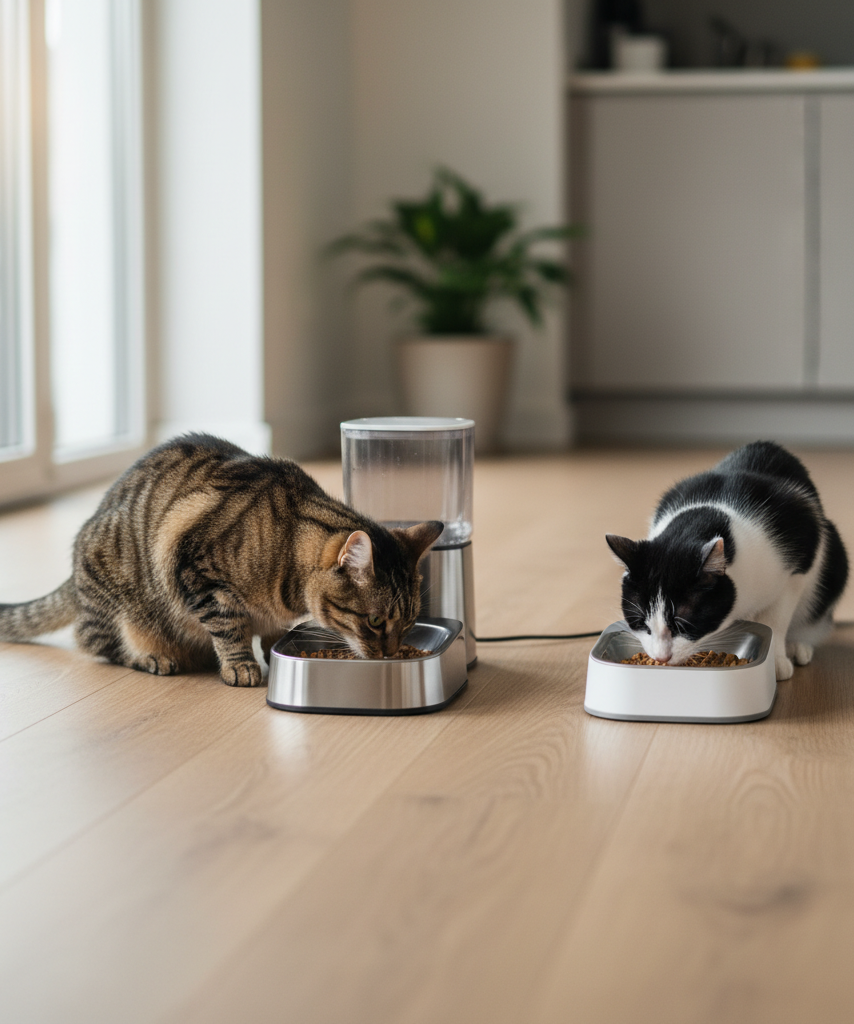
When those issues are present, separate feeders are usually more practical than trying to “train around” the problem. Even two standard auto feeders placed in different spots can dramatically reduce competition.
Best feeder types for multiple cats
1. Shared timed feeders
A timed feeder is the simplest option and often the cheapest starting point. It works best if your goal is just to automate meal timing. For a multi-cat household, however, it is only a strong solution when both cats are behaviorally compatible at the bowl.
Best for: households with similar-size cats, one dry-food type, and low mealtime conflict.
Pros:
- budget-friendly
- easy to set up
- works well for consistent meal times
Cons:
- poor fit if one cat steals food
- weak portion protection in multi-cat homes
- does not help with separate diets
2. App-controlled automatic feeders
App-controlled models add more flexibility. You can schedule multiple meals, adjust portions, and in many cases check whether the feeder delivered food correctly. That is useful if you want tighter calorie control or need to manage feeding while away from home.
Still, app control does not magically solve multi-cat behavior. If both cats are sharing the same bowl area, the more confident cat can still take more than its share. Think of app features as a control upgrade, not a fairness upgrade.
Best for: owners who want better scheduling, portion tweaks, and remote oversight.
3. RFID or microchip feeders
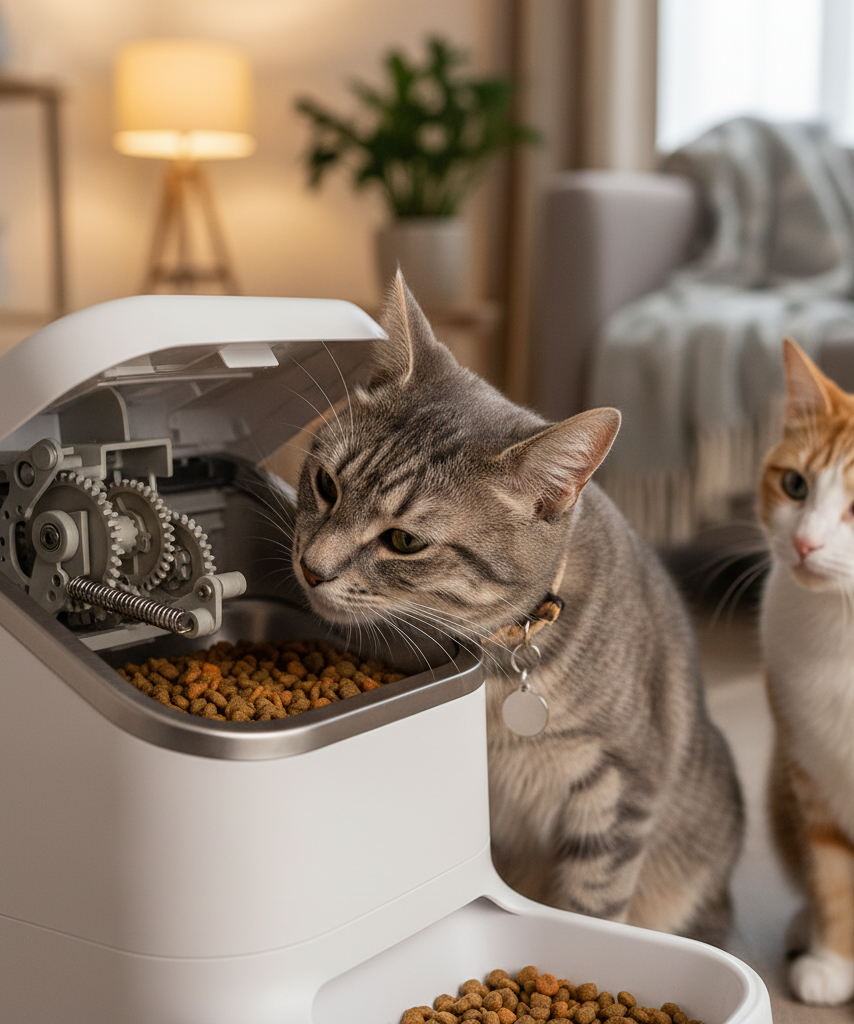
This is the category that usually works best when people say they need an automatic feeder for multiple pets but are really dealing with food stealing. RFID cat feeder and microchip cat feeder models are designed to open only for the correct pet, or to pair with an access tag so one cat cannot raid the other cat’s food.
That makes them especially useful if:
- one cat is on a weight-control plan
- one cat needs prescription food
- one cat is a grazer
- the other cat is a food thief
If your real issue is access control, this type of feeder is often worth the extra cost. A strong example of that approach is an automatic pet feeder with collar sensor for multi-pet feeding, which fits the exact problem of one pet trying to eat another pet’s portion.
Best for: different diets, bully eaters, medical feeding plans, and homes where standard feeders keep failing.
How to prevent one cat from eating both portions
This is usually the deciding factor when choosing the best auto feeder for a multi cat home. If one cat keeps stealing, the problem is not the timer. It is the feeding environment.
Here are the fixes that actually help:
Use physical separation
Place feeders in different rooms, on opposite sides of a barrier, or far enough apart that one cat cannot hover over both bowls. Even good cats can become opportunistic when food drops at the same time.
Choose the right feeder style for the behavior problem
- **Mild competition:** two separate standard feeders may be enough
- **Moderate stealing:** place feeders out of sight lines and stagger access
- **Severe food stealing:** RFID or microchip-controlled access is usually the better answer
Match meal style to the cat
Cats that bolt their food often do better with smaller scheduled meals throughout the day. Grazers often need protected access so they can come back later without losing their portion.
Do not assume equal bowls mean equal eating
Two portions dispensed into one area do not guarantee each cat gets the same calories. In multi-cat homes, fairness usually comes from separation and access control, not just measured output.
Key features to compare before buying
When comparing the best automatic cat feeder for multiple cats, look past generic marketing claims and focus on these practical details:
Portion control accuracy
If you are trying to manage weight or prevent overeating, portion consistency matters more than flashy features.
Number of daily meals
More scheduling flexibility helps if one cat does better with smaller, more frequent meals.
Access control
This is the big one for multi-cat households. If your cats compete, RFID or microchip access can matter more than Wi-Fi.
Food capacity
A larger hopper is convenient, but it is not a real advantage if the wrong cat is still getting the food.
Bowl design and placement flexibility
A feeder that works well in a tight corner may fail in an open traffic area where one cat can ambush the other.
Backup power and reliability
Any automatic pet feeder for multiple pets should keep working during short outages and should not be easy for a determined cat to tip, paw open, or jam.
Common mistakes people make before buying
A lot of multi-cat feeder frustration comes from buying for the wrong problem. These are the mistakes that waste the most money:
- buying one feeder when the real need is controlled access
- focusing on app features when food stealing is the actual issue
- ignoring whether the cats eat different foods
- putting both bowls too close together
- assuming the most expensive feeder is automatically the best fit
- forgetting that some cats need a short training period before accepting a new feeder
Buyer checklist: which setup should you choose?
Choose a shared feeder if:
- both cats eat the same food
- both cats finish meals similarly
- neither cat guards food
- you want the most affordable automation option
Choose two separate automatic feeders if:
- you need better per-cat portion control
- both cats can use normal feeders but should not share one bowl
- you want a simpler setup before moving to RFID models
Choose an RFID or microchip feeder if:
- one cat steals meals
- one cat is on prescription or weight-management food
- your cats eat at different speeds or styles
- peace at mealtime matters more than lowest upfront cost
Who this type of feeder is best for
The best automatic feeder for multiple cats is ideal for:
- busy households with predictable feeding routines
- owners trying to manage calories more consistently
- homes where cats need meals while humans are out
- multi-cat households with mild to severe food competition
- pet parents managing different diets or medical nutrition plans
It is less useful if your cats primarily eat wet food only, need frequent supervised medication with meals, or become highly stressed by mechanical feeding devices. In those cases, automation may still help, but the setup needs extra thought.
FAQ
Can one automatic feeder work for two cats?
Yes, but only if the cats eat the same food, behave calmly at meals, and do not steal each other’s portions. For many multi-cat homes, separate feeders work better.
How do I stop one cat from eating the other cat’s food?
Start with feeder separation and different feeding locations. If the stealing continues, an RFID or microchip cat feeder is usually the most effective upgrade.
Are RFID feeders worth it for multi-cat homes?
Usually yes—especially when one cat needs a different diet, one cat grazes, or one cat bullies the other away from the bowl. They cost more, but they solve a problem standard feeders often cannot.
What feeder works best if cats eat different diets?
An RFID or microchip-style feeder is typically the best choice because it helps restrict access by pet instead of just dispensing food on a schedule.
Final takeaway
If you are choosing the best automatic cat feeder for multiple cats, do not just shop for convenience. Shop for the problem you are actually trying to solve. If your cats share food peacefully, a standard timed or app-controlled feeder may be enough. If mealtimes involve food stealing, prescription diets, or portion disputes, the feeder that actually works is usually the one that separates access—not just the one that drops kibble on time.
Leave a Reply