


Airline-Approved Cat Carrier Dimensions: How to Measure Before You Book a Flight
Before booking a flight, measure your cat’s length and height, then compare those numbers with the carrier’s interior dimensions and the airline’s under-seat size limits, because both pet comfort and carrier fit matter. If you only check the label on the bag and skip the actual measurements, you can end up with a carrier that looks airline approved online but still fails at check-in, boarding, or under-seat stowage.
The safest workflow is simple: measure your cat in a natural standing position, measure the carrier both outside and inside, then compare everything against the airline’s stated under-seat limit for your route or aircraft. That extra ten minutes can save you from buying the wrong size, rebooking under stress, or arriving at the airport with a carrier that technically fits your cat but not the plane.
Quick Answer: Why Airline-Approved Cat Carrier Dimensions Matter
- Your cat must fit comfortably inside the carrier, not just squeeze in.
- The carrier must also fit within the airline’s under-seat limit.
- Interior dimensions and exterior dimensions are not the same thing.
- Soft-sided carriers can flex slightly, but they still cannot ignore the airline’s size rule.
- The right time to measure is before you book, not the night before the flight.
Dimension Reference Block
Use this order every time:
- Measure your cat’s body length from chest to base of tail.
- Measure your cat’s standing height from floor to top of shoulders or head, depending on how the carrier is shaped.
- Check the carrier’s interior length, width, and height.
- Check the carrier’s exterior dimensions, including rigid frame sections.
- Compare the carrier’s exterior size with the airline’s under-seat limit.
- Compare the carrier’s interior size with your cat’s real body measurements.
A carrier is only a good fit when both comparisons work at the same time.
How Airlines Measure Cat Carriers for Flying
When people search for cat carrier airline approved size, they often assume the product label settles the question. It does not. Airlines care about whether the carrier fits in the cabin space they allow, especially under the seat in front of you.
That usually means they are looking at the carrier’s:
- exterior length
- exterior width
- exterior height
- shape under pressure or compression
- ability to slide fully under the seat
Some airlines publish one general set of limits, but actual fit can still vary by aircraft type. That is why a carrier can look acceptable on paper and still feel risky in real cabin use. A thick base, a stiff frame, protruding corners, or a rounded top can all affect how easily it stows.
Exterior dimensions matter more at the airline check stage
For airline compatibility, the outside of the carrier is what matters first. If the outside size is too large, staff will not care that the inside is comfortable. This is the first filter in the airline approved cat carrier dimensions decision.
Interior dimensions matter more for your cat’s comfort
Once the carrier passes airline sizing, the inside becomes the next question. Your cat should be able to lie down naturally, turn with some ease, and stay in the carrier without looking folded into the shape.
How to Measure Your Cat Before Choosing a Carrier
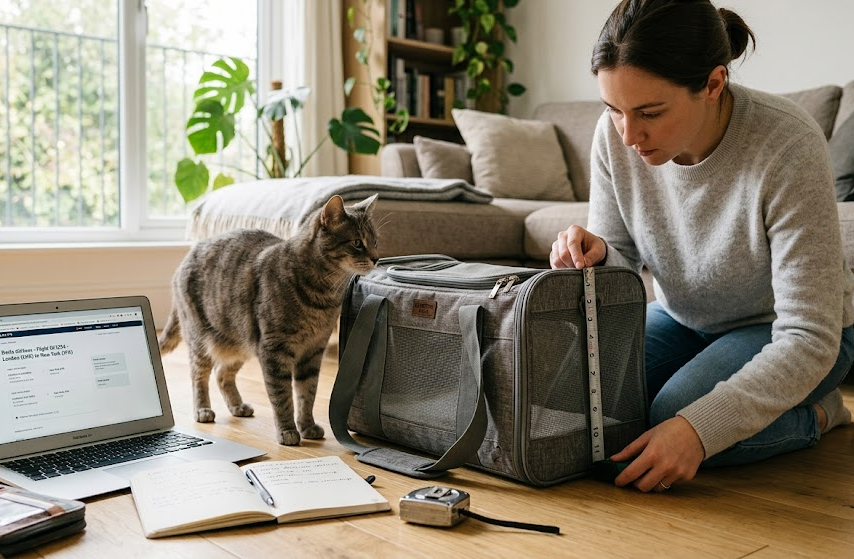
If you want to know how to measure cat carrier for airline use properly, start by measuring the cat first. This is the part many shoppers skip, and it is exactly why some “approved” carriers end up being too short or too low inside.
Measure cat length
Have your cat stand in a normal posture. Measure from the front of the chest to the base of the tail. Do not include the tail itself. This gives you a more useful body-length number for comparing with the carrier interior.
Measure cat height
Measure from the floor to the top of the shoulders or top of the head, depending on whether the carrier has a squared top or a curved top. If the carrier ceiling curves inward, use the more conservative comparison.
Add breathing room, not excessive empty space
Your cat does not need a giant cabin bag, but it does need enough room to settle naturally. In practical terms, your cat should have space to:
- stand without the top pressing down harshly
- turn modestly
- lie down in a relaxed position
- remain inside for airport time, boarding, and the flight itself
If the carrier is technically within airline size rules but your cat fills the whole interior edge to edge, it is not a good match.
How to Measure the Carrier Correctly
This is where cat carrier dimensions for flying often get misunderstood. Shoppers read one product line, see a length x width x height listing, and assume that is enough. But you need to know whether those numbers refer to interior size, exterior size, or a mix of both.
Measure the carrier exterior
Use a tape measure and record:
- longest point from front to back
- widest point side to side
- highest point from floor to top
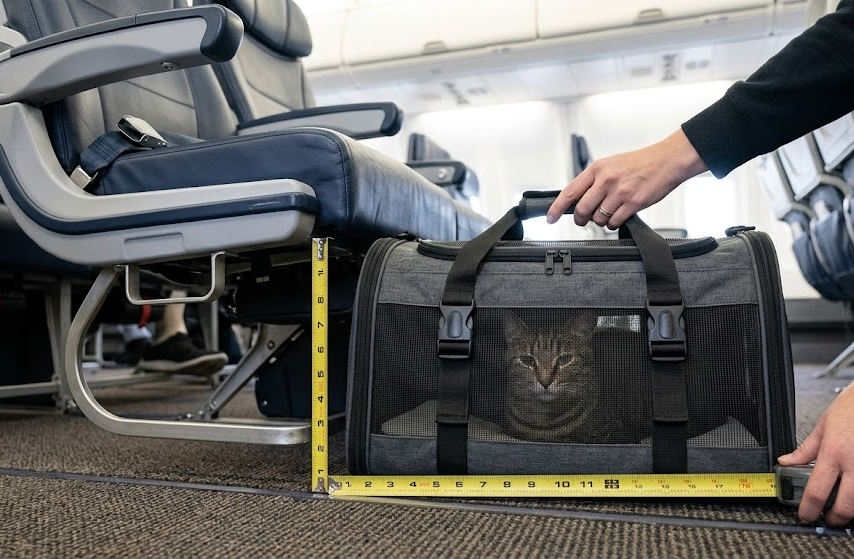
If the carrier has rigid trim, feet, wheels, extra-thick seams, or a reinforced top, include them. That is the version most relevant for the airline under-seat check.
Measure the carrier interior
Then measure the usable inside space:
- interior floor length
- interior floor width
- interior height at the highest useful point
If the top curves inward or padding takes up room, treat the usable interior size as smaller than the outer shell suggests.
Why interior and exterior dimensions can differ a lot
A carrier may lose usable room because of:
- padded walls
- thick seams
- frame rods
- structured base inserts
- curved roof panels
That is why a bag advertised as a certain size can still disappoint once your cat is actually inside.
Soft-Sided Compression and Under-Seat Fit
A lot of people buying an under seat pet carrier size for cabin travel choose a soft-sided model for one reason: a small amount of flexibility can help with stowage. That can be useful, but it is not a free pass.
Soft-sided compression helps when:
- the top panel can dip slightly under the seat edge
- the airline limit is close and the bag has mild give
- the carrier keeps its shape well enough to stay safe for the cat
Soft-sided compression does not help when:
- the base is too long or too wide
- rigid side supports prevent meaningful flex
- the carrier becomes too cramped once compressed
- the airline staff judge it as clearly oversized before boarding
The practical takeaway is this: slight flex is a margin, not a strategy. When comparing cat carrier size for airplane travel, always aim to fit the published rule first and treat soft-sided give as backup tolerance, not your main plan.
Common Size Mistakes That Cause Booking Stress
Most booking mistakes come from one of these problems:
- buying based on the phrase “airline approved” without checking measurements
- measuring only the outside and ignoring the interior fit for the cat
- checking only the interior and forgetting the under-seat limit
- using generic airline dimensions instead of the carrier’s route-specific rule
- assuming a soft-sided carrier can compress far more than it safely should
- forgetting to include reinforced edges, pockets, or frame pieces in the outer measurement
If you want to avoid airport rejection stress, think in terms of compatibility, not marketing claims. Your cat, the carrier, and the aircraft space all have to match.
Pre-Booking Checklist for Cat Carrier Airline Approved Size
Before you book, confirm all of these:
- your cat’s body length
- your cat’s standing height
- the carrier’s interior length
- the carrier’s interior height
- the carrier’s exterior dimensions
- the airline’s current under-seat limit
- whether your route or aircraft has tighter cabin fit constraints
- whether the carrier is soft-sided or rigid where it matters most
- whether your cat can stay inside calmly for the full travel window
This short checklist catches most of the mistakes that lead to rushed reordering or last-minute gate anxiety.
How Big Can a Cat Carrier Be for a Flight?
The answer depends on the airline’s under-seat rule, not on one universal standard. In practice, the carrier can only be as big as the airline allows and still be large enough inside for your cat to rest safely. That is why there is no single best answer for flying with a cat carrier in every situation.
Instead of asking for one universal maximum, ask two better questions:
- What is the airline’s allowed exterior carrier size?
- Does that carrier still provide enough interior room for my cat’s length and height?
If the answer to either question is no, keep looking.
FAQ
How big can a cat carrier be for a flight?
It can only be as large as the airline’s under-seat limit allows while still giving your cat enough interior room to rest comfortably. There is no universal maximum that works for every airline or aircraft.
Do airlines measure soft-sided pet carriers?
They can. Even if a soft-sided carrier has some flexibility, airlines may still assess whether it appears to fit the allowed cabin size. Soft-sided fabric helps a little, but it does not replace actual measurement.
How much room should a cat have inside the carrier?
Your cat should have enough space to lie down naturally, turn with some ease, and sit or stand without being forced into the roof. The goal is practical comfort within cabin limits, not the largest possible bag.
Summary Takeaway
The safest way to choose airline approved cat carrier dimensions is to measure in two directions at once: your cat against the carrier interior, and the carrier exterior against the airline’s under-seat limit. If both fit, you are in good shape. If only one fits, it is the wrong carrier for that flight.


Leave a Reply